
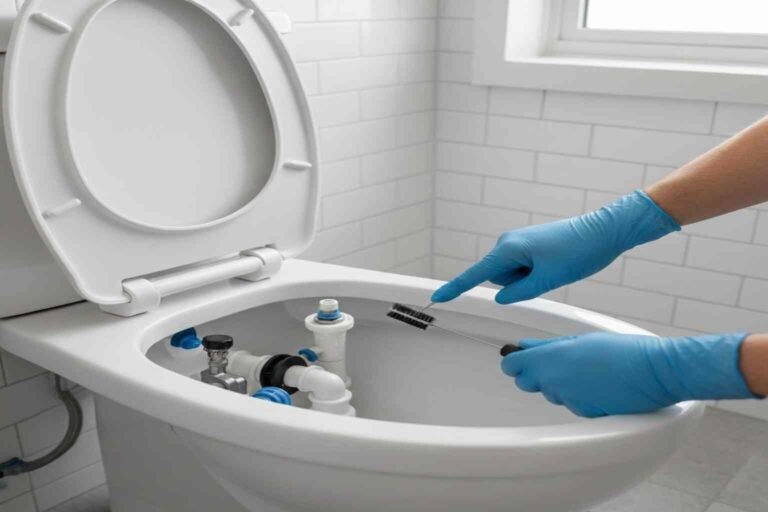
Have you ever used your toilet and thought that the tank is being slow to fill up? Or waits till the water creeps at such a slow rate it is trying your patience? A toilet that fills slowly may make a visit to a bathroom aggravating. A minor problem is soon exasperating when it occurs on a daily basis. The good news? A major part of the causes of slow filling is not complex, common, and easy to correct once aware of what is occurring. We will look at the best reasons why this issue has occurred and how you can restore your toilet to a smooth and quick filling.
1. Faulty or Stuck Float Ball
The floating ball forms an important component of the filling of your toilet. Its task is to regulate the amount of water used in the tank following each flush, as per the best plumbers. However, once the float ball becomes entrapped, weary or mis-aligned it cannot rise and fall as it must. This prevents it sending the signal to the tank to fill effectively resulting in slow entry of water into the tank.
A float ball that has become stuck can be easily resolved by loosening the float arm so that it can move more easily. In case the float is broken or worn out, skilled plumbers can help ensure the float is properly aligned and changing it is the most appropriate solution. It is a minor fix that can make a huge difference with regard to the speed at which your tank is topped off. A new float should work well and you will find that the difference in the water flow and refill time is noticeable.
2. Clogged or Dirty Fill Valve
The fill valve is significant in directing the supply line of water into the toilet tank. The hard water, the debris or the sediments may accumulate over time as minerals inside the valve. This accumulation constricts the water passageway and slows down its flow.
When the blockage is mild, cleaning the fill valve is a sufficient measure. Dugging out the dirt by simply removing the top cover and flushing would bring water back to its normal flow. However, in case of mineral deposits being unusually heavy or the valve being worn out, change of valve might be required. An inexpensive and easy to install new valve is available. When changed, the tank will fill more quickly and effectively and your toilet will be on its smooth running again.
3. Poor House Water Pressure
At other times, it is not even the fault of the toilet but the water pressure in your house. In case you have found that the other taps or showers have low pressure, it could be a system wide problem. The low pressure does not allow the tank to fill at a natural rate since the water flowing into the house is small.
Begin by turning off the valve in your toilet. When it is partly closed, the pressure of the water reduces. Open it fully to restore flow. When the pressure of water is low in the whole house it could be a partially blocked main line, outdated pressure regulator, or leaks in the plumbing. Professional assistance in such situations is likely to save time and eliminate additional harm.
4. Accretion of the Supply Line
The supply line is a small pipe which though not very big connects your toilet with the water source. Over time and particularly at places where there is hard water, sand may build up inside this line. This accumulation causes a constriction of the pipe and slows down the flowing water into the tank.
Such a small amount of sediment can cause a significant decrease in the water flow. This problem is normally addressed by cleaning or replacing the supply line. In case water in your house is rich in minerals, it is important to clean it periodically. Replacement of the line can be done very easily as well as in a short time the filling speed of the tank would resume. It also avoids the following stalling due to accumulation.
5. Worn or Leaking Flapper
The flapper closes the water in the tank and only rises during flushing. When the flapper becomes old, warped or damaged, it is not able to close all the way. This causes slow leakage into the bowl even in case there is no use of the toilet. The water is leaking out, and thus it takes a long time to fill the tank or have the feeling that the tank is full.
One of the simplest toilet repairs is a replacement of the flapper. New flappers are cheap and can be installed without any tools. As soon as the flapper seals up, the tank is filled in its usual way and remains in the ordinary state till the next flush. It is also useful in water saving and avoiding unnecessary noise during refilling.
6. Aged or broken Toilets Components
The components contained in the toilet tank deteriorate with time of usage. Rubber components get brittle, plastic components get shape and metal components could get rusted/corroded. Any of these problems may interfere with the normal circulation of water into the tank.
A toilet can be reinstated to its new functionality by installing a new fill valve, flapper, float or overflow tube, according to the professional crew. In case of an extremely old toilet that is in constant trouble, it could be something to consider updating to a new, water-efficient toilet.
Conclusion
A slow-filling toilet might be a minor inconvenience, yet the reasons are often easily determined, and the problem is often not difficult to fix. It can be a stuck float ball, a clogged valve, old parts, or low pressure, but there is an easy solution to each of them. This can be done by simple upkeep where you cleanse mineral deposits and make sure that the parts of your toilet are in good condition, which will ensure that in the long run, slow refilling will not be experienced.
